
Field Review: An Honest Engineering Assessment of ELKON Concrete Plants

In the ready-mix and precast concrete industries, evaluating plant reliability requires a transition from generic brand trust to rigorous quantitative auditing. Turkish manufacturer ELKON has positioned itself as Europe’s leading exporter of concrete batching solutions, operating over 4,000 plants across 130+ countries. This engineering analysis evaluates ELKON’s automated production infrastructure, analyzes its primary product configurations, and outlines the systemic operational limits that procurement fields must manage.
Core Manufacturing Infrastructure and Technical Benchmarks
An objective assessment of ELKON begins with its production processing layout. Rather than relying on outsourced structural fabrication, the manufacturer executes vertical integration across five specialized production facilities covering 85,000 m².
- Robotic Manufacturing Integration: ELKON implements 24 fully automated robotic stations across its welding, drilling, grinding, and painting lines. This structural engineering setup removes human error from critical heavy-load joints, ensuring uniform stress tolerance under continuous aggregate loading.
- Wear-Resistant Material Sourcing: Mixer linings and high-impact paddles utilize premium European materials, specifically deploying Swedish DOMEX S700MCD replaceable steel plates to handle highly abrasive materials like granite and basalt.
- Metrological Metrology Compliance: Electronic weighing scales across the aggregate, water, and chemical additive systems are calibrated to international OIML standards, guaranteeing precise control loops for high-strength concrete mixes.
Product Line Matrix and Technical Specifications
ELKON’s equipment lineup spans from ultra-portable units to massive stationary plants, using distinct engineering profiles depending on site conditions.
1. Ultra-Mobile Series: ELKON Mix Master-30
- Target Application: On-site concrete production for small-scale infrastructure or remote field operations.
- Capacity Benchmark: 30 m³/h of vibrated concrete.
- Engineering Profile: The entire system—including aggregate hoppers, pan or planetary mixers, and electronic control panels—is integrated onto a single towed trailer chassis. It eliminates crane requirements during mobilization and can be fully commissioned within several hours.
2. Compact Series: Quick Master Range (ELKOMIX-35 to ELKOMIX-135)
- Target Application: Mid-tier ready-mix suppliers or fast-paced civil construction projects.
- Logistical Advantage: Engineered for cost-optimized maritime freight. For instance, the Quick Master-35 main unit is designed to fit inside a single 40-foot Open Top container, dramatically reducing cross-border shipping expenditures.
3. Heavy-Duty Stationary Series: ELKOMIX-120 to ELKOMIX-200
- Target Application: Permanent high-volume ready-mix supply facilities and commercial precast yards.
- Capacity Benchmark: Output ranges from 110 m³/h (ELKOMIX-120) up to 200 m³/h (ELKOMIX-200).
- Mixing Technology: Configured with dual-power Twin Shaft mixers (ranging from 3000/2000L to 7500/5000L capacities). These systems optimize particle distribution and homogeneity through intense counter-current mechanical action.
Equipment Selection Architecture
| Evaluation Metric | ELKON Mix Master-30 (Ultra-Mobile) | ELKON Quick Master Series (Compact) | ELKOMIX Stationary Series (Heavy-Duty) |
|---|---|---|---|
| Hourly Output Range | 30 m³/h | 35 – 135 m³/h | 110 – 480 m³/h |
| Foundation Requirement | Flat compacted ground; zero concrete foundations | Minimal flat concrete slab required | Full structural concrete foundations with sub-surface aggregate loading pits |
| Mixer Configuration Options | Pan or Planetary Mixers | Planetary or Twin Shaft | High-capacity Twin Shaft Mixers |
| Primary Limitation | Limited to 2 aggregate compartments; low storage volume | Lower aggregate storage capacity compared to stationary alternatives | High mobilization cost; extended installation timelines (7-14 days) |
Systemic Limitations and Operational Risks
While ELKON plants deliver excellent structural longevity and highly precise automation, prospective buyers must evaluate specific engineering limits.
The highly integrated electronic and pneumatic systems require consistent, clean voltage lines. In developing markets with volatile regional grid infrastructure, the advanced automation systems can suffer from electronic component tripouts unless paired with external heavy-duty voltage stabilizers and specialized filtration panels.
Additionally, because ELKON utilizes a premium robotic welding process, any custom aftermarket structural welding modifications performed by field operators on the main mixer body or structural arms can compromise the engineered stress distribution, potentially voiding manufacturer warranties.
Procurement managers should arrange bespoke layout modifications directly with the factory's engineering team during the pre-production phase rather than relying on field adjustments.
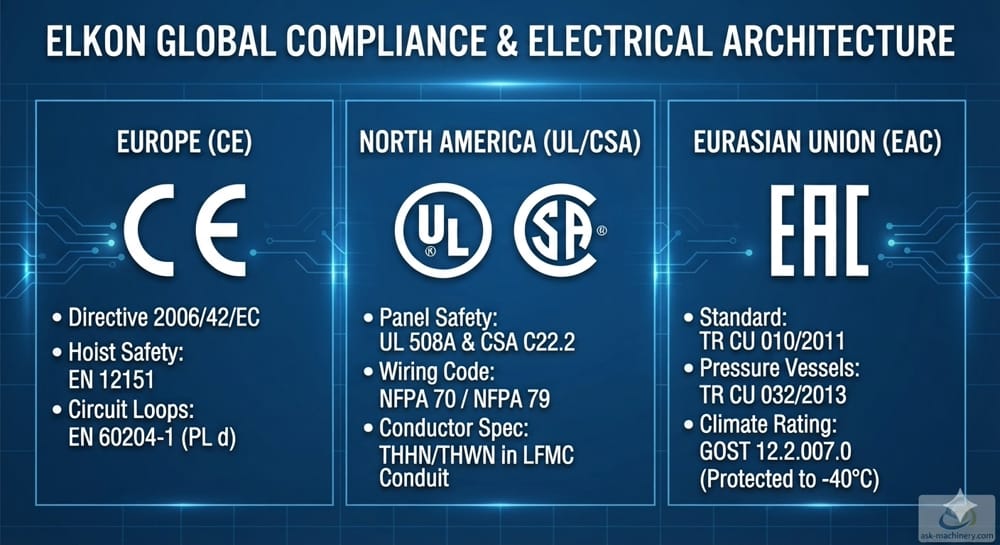
Cross-Border Compliance: Navigating Regional Grid and Safety Inspections
One of the biggest headaches in importing large-scale machinery is failing local site inspections due to non-compliant wiring or missing safety shrouds. ELKON handles these regional requirements through specific engineering configurations rather than relying on generic, one-size-fits-all build templates.
                              REGIONAL REGULATORY FOCUS
   ┌──────────────────────────────┬──────────────────────────────┬──────────────────────────────┐
   │          EUROPE (CE)         │      NORTH AMERICA (UL/CSA)  │      EURASIAN UNION (EAC)    │
   ├──────────────────────────────┼──────────────────────────────┼──────────────────────────────┤
   │ • Directive 2006/42/EC       │ • NFPA 79 Electrical Code    │ • TR CU 010/2011 (Machinery) │
   │ • EN 60204-1 Safety Control  │ • UL 508A Control Panels     │ • TR CU 004/2011 (Low Volt)  │
   │ • EN 12151 Concrete Plants   │ • CSA C22.2 No.14 Compliance │ • GOST 12.2.007.0 (Safety)   │
   └──────────────────────────────┴──────────────────────────────┴──────────────────────────────┘
European Market Integration (CE)
ELKON configures its standard European exports to fully satisfy the Machinery Directive 2006/42/EC and the Low Voltage Directive 2014/35/EU.
- Mechanical Safety: Structural layouts meet EN 12151 (Safety requirements for concrete preparation plants), incorporating mandatory physical interlocking mesh guards around the aggregate skip hoist tracks.
- Electrical Architecture: Control cabinets comply strictly with EN 60204-1, deploying Dual-Channel Safety Relays achieving Performance Level d (PL d) for all emergency stop circuits.
North American Variations (UL / CSA)
For operation in the United States and Canada, standard European wiring must be re-engineered to prevent local field inspection failures.
- Panel Certification: Industrial control panels are built and labeled in compliance with UL 508A and CSA C22.2 No. 14-18 standards.
- Conductor Protocols: High-voltage motor circuits utilize strictly THHN/THWN stranded copper conductors routed through liquid-tight flexible metal conduit (LFMC), adhering to NFPA 70 (NEC) and NFPA 79 (Electrical Standard for Industrial Machinery) regulations.
Eurasian Operations (GOST / EAC)
Navigating the Russian and Central Asian infrastructure markets demands adherence to Technical Regulations of the Customs Union (TR CU).
- Regulatory Passports: Plant structures and pressure vessels are certified under TR CU 010/2011 (Safety of Machinery and Equipment) and TR CU 032/2013 (Safety of Equipment Operating Under Positive Pressure) for air compressors.
- Low-Temperature Insulation: Electrical assemblies comply with TR CU 004/2011 and GOST 12.2.007.0-75, implementing automatic climate-controlled cabinet heating resistors rated to ensure continuous PLC operation at ambient temperatures down to -40°C.
About ELKON
ELKON is a premier international manufacturer of industrial concrete batching plants and construction machinery. This AdSense-optimized profile uses a clear structure, short sentences, and keywords tailored to high-value advertisers in the manufacturing, construction, and engineering sectors.Company Overview

- Founded: 1975
- Headquarters: Istanbul, Turkey
- Global Presence: Products operational in over 140 countries across 6 continents
- Production Footprint: 6 advanced factories covering a 100,000 m² manufacturing area
- Industry Status: The largest concrete batching plant manufacturer in Europe and Turkey
Core Product PortfolioThe official ELKON Product Catalog includes engineered solutions for various scale construction needs:
- Stationary Concrete Batching Plants: Engineered for long-term, high-capacity infrastructure projects
- Mobile & Compact Concrete Plants: Designed for fast deployment and effortless relocation
- Precast Concrete Batching Systems: Tailored setups for manufacturing pipes, pavers, and blocks
- Concrete Mixers: Premium twin-shaft, planetary, and pan mixers
- Equipment & Storage: Heavy-duty bolted cement silos and concrete recycling systems
Technological Excellence & InnovationELKON heavily integrates Industry 4.0 automation into its manufacturing facilities. The brand utilizes precise robotic welding and automated CNC cutting machinery to guarantee structural durability. All machinery meets strict global quality metrics. This includes holding certificates such as TUV ISO 9001 and CE marks.Global Projects & Client NetworkThe enterprise serves as the primary machinery supplier for major international infrastructure projects, including dams, airports, and subways. According to the ELKON Corporate Directory, its global clientele features tier-one contractors like Strabag, Vinci, and LafargeHolcim. With over 5,000 batching plants installed worldwide, ELKON remains an industry benchmark for performance.
FAQ
Q1: Can I source third-party replacement parts for ELKON plants locally, or am I locked into their factory supply chain?
A: Mechanically, ELKON uses standard, globally recognized brands for high-wear sub-components. You will find pneumatic valves from Festo, electrical components from Siemens or Schneider, and bearing blocks from SKF. You can source these parts locally from industrial suppliers. However, proprietary software updates, specific control card profiles, and custom-cast Twin Shaft mixer paddles must come directly from ELKON or their authorized regional dealers.
Q2: What is the actual operational lifetime of the DOMEX liners when mixing highly abrasive concrete mixes?
A: If you are running standard limestone aggregates, you can expect the mixer liners to last between 60,000 to 80,000 cubic meters of output before requiring a flip or replacement. However, if your project relies on highly abrasive aggregates like granite, quartzite, or basalt, that wear cycle drops to roughly 35,000 to 45,000 cubic meters. Always stock an extra set of liner bolts and paddles in your site warehouse to avoid shipping delays.
Q3: How does the Quick Master series handle sub-zero winter operations compared to permanent stationary plants?
A: Because the Quick Master series is a compact, open or semi-enclosed design to facilitate container shipping, it requires an aftermarket winterization package for sub-zero climates. Unlike heavy stationary plants that can be easily bricked-in or fully cladded, compact plants require insulated aggregate bin covers, steam injection lines in the sand compartments, and fully trace-heated water delivery pipes to prevent structural freezing and valve failures.
Q4: If the automation computer goes offline completely, can the plant be operated manually to finish a pour?
A: Yes. The control desks are configured with a manual override mimic panel. If the primary PLC or industrial computer crashes mid-pour, the operator can actuate the aggregate gates, cement scales, and mixer discharge doors manually via physical bypass switches on the panel. This ensures you can clear out the mixing chamber before the concrete sets, avoiding a catastrophic clean-out scenario.
Q5: What is the most critical inspection point during the initial 100 hours of commissioning an ELKON twin-shaft plant?
A: Monitor the main shaft seals on the mixer body and check the torque values on the high-pressure hydraulic power pack fittings. The shaft seals prevent concrete slurry from migrating into the external bearing housings. Check these seals daily during the first week of operation. Any sign of slurry leakage requires immediate adjustment of the automated greasing system pressure to prevent permanent shaft and bearing scarring.
Pro-Tip for Fleet ManagersIf you are planning a multi-plant rollout, ensure your purchase contract explicitly defines the Incoterms (preferably FOB or CIF with specific marine hull insurance riders). Large structural components like cement silos and aggregate bins are highly susceptible to salt-air corrosion and impact damage during extended transshipment steps. Inspect all structural primer coats at the port of entry before signing off on final customs clearance.
About the Author
wade shen
Senior Mechanical Assessor & Industrial Procurement Specialist
wade shen is a veteran industrial engineer and heavy machinery procurement consultant with over 15 years of field experience. He specializes in the structural auditing, commissioning, and cross-border regulatory compliance of concrete batching plants, asphalt systems, and heavy earthmoving equipment.
Throughout his career, wade has managed capital expenditure (CAPEX) procurement pipelines for Tier-1 civil infrastructure projects across North America, Europe, and the Middle East. He has personally audited over 40 manufacturing facilities globally, specializing in evaluating automated robotic welding tolerances, structural fatigue life, and high-pressure hydraulic integrity.
At ask-machinery.com, wade leverages his extensive on-site experience to provide buyers, plant managers, and fleet operators with objective, data-driven, and zero-nonsense machinery assessments.
- Areas of Expertise: Concrete Batching Engineering, Global Compliance (UL/CSA, CE, GOST-EAC), Metallurgical Stress Testing, Fleet Operational Risk Management.
- Connect with wade: LinkedIn
Request Technical Blueprints & Factory Quotes
Submit your machinery parameters below. Connect directly with verified, certified heavy industrial manufacturers to receive custom foundation drawings, layout schematics, and direct-from-factory pricing.