
Why Do HZS60 Concrete Plant Skip Hoists and Batch Scales Fail?
An industrial troubleshooting manual detailing why HZS60 skip hoists experience brake drift and how to resolve scale sensor hysteresis errors.

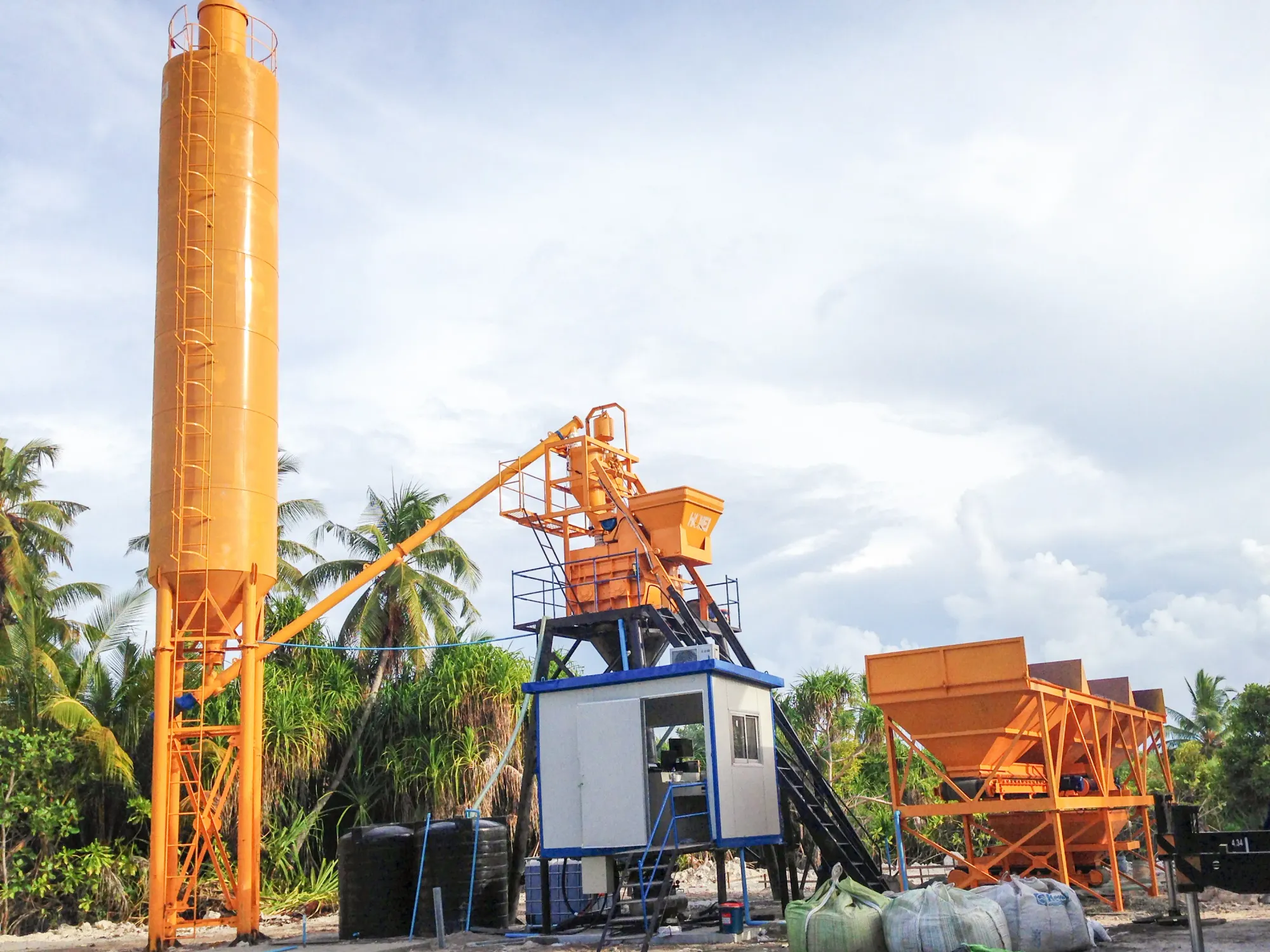
Metrological Overview & Skip-Hoist Mechanical Dynamics
In medium-capacity infrastructure projects, highway overpass developments, and regional precast production centers, the HZS60 Stationary Concrete Batching Plant serves as the primary operational asset. Delivering a reliable nominal production output velocity of 60 m³/h, this plant configuration utilizes a compact vertical skip-hoist bucket track system rather than an expansive horizontal conveyor belt matrix. The skip hoist pulls raw sand and gravel aggregates up a steep 60-degree steel rail profile via a high-torque electric winch motor, discharging the material directly into the upper charging throat of a 1.0 m³ horizontal compulsory twin-shaft mixer.
While the vertical skip design reduces the required factory land layout footprint by up to 50% compared to belt-fed models, it subjects the plant's mechanical systems to extreme cyclical kinetic stresses.
The abrupt stopping, holding, and dumping sequences of a fully loaded 2,500 kg skip car create severe shock loads. If the winch motor magnetic brakes drift, the lifting cables fray, or the automated strain-gauge load cells experience vibration-induced signal lag, the automated batching sequence fails. This triggers immediate production shutdowns, raw material loss, and significant structural safety risks.
This technical operations manual isolates the mechanical and electrical root causes of HZS60 system failures, defines strict physical tolerances, and outlines a structured remediation checklist for site engineers.
The 3 Critical Failure Pillars of HZS60 Operations
To restore a locked-down HZS60 plant to active status during an unexpected project site stoppage, maintenance crews must isolate three independent failure vectors.

1. Skip Winch Magnetic Brake Slip (Positional Drift)
The skip car relies entirely on an electromagnetic disk brake system integrated into the rear housing of the dual-speed winch motor to hold its position on the 60-degree rail during batch changes.
- The Slippage Mechanism: Dust from nearby aggregate bins and moisture combine to coat the internal friction lining pads. When the plant operates at maximum capacity during hot summer cycles, the electromagnetic coils heat up, dropping their magnetic torque hold. The loaded bucket experiences positional drift, slipping backward down the track. This triggers a safety timeout error on the Siemens PLC screen and halts the automated sequence.
2. Steel Wire Rope Tensile Fatigue & Sheave Misalignment
The hoist bucket is suspended by twin high-tensile steel wire ropes winding around a grooved drum core.
- The Wear Mechanism: If the guide sheaves at the top of the tower drift out of alignment by more than 2.0 degrees, the steel wire rope will rub unevenly against the outer sheave flanges. This friction quickly wears down the outer wire crowns, causing individual wires to snap. If undetected, the cable suffers sudden tensile failure under a full load, sending the 2-ton aggregate skip bucket crashing down the steel tracks and destroying the lower limit switches.
3. Aggregate/Cement Scale Sensor Hysteresis (Zero-Creep)
The 1.0 m³ mixing system uses independent hopper scales hanging from three S-type strain-gauge load cells to measure concrete components.
- The Signal Error Loop: High-frequency vibration from the aggregate bin electric vibrators passes directly into the scale frames. These continuous vibrations create micro-cracks in the load cell's internal potted rubber environmental seals. Moisture and fine dust seep into the sensor housing, skewing the internal Wheatstone bridge resistance. The scale displays a classic zero-creep defect, meaning it fails to return to absolute
0.0 kgafter dumping, causing the PLC to under-dose subsequent batches.
Technical Specifications & Machinery Tolerances
The specification matrix below outlines the strict physical boundaries, electrical tolerances, and mechanical parameters required to run a zero-error HZS60 batching line.
| Operational Siting Node / Axis | Standard Engineering Target | Critical Failure / Fault Threshold | Precision Measurement Device |
|---|---|---|---|
| Winch Motor Brake Disc Gap | 0.4 mm to 0.6 mm (Optimal) | > 1.2 mm (Immediate Brake Slip) | Carbon Steel Metric Feeler Gauges |
| Skip Track Parallelism Deviation | ≤ 2.0 mm across rail axis | > 5.0 mm (Bucket Binding / Jam) | Digital Laser Alignment Tool |
| Wire Rope Diameter Reduction | Original Spec (e.g., 14.0 mm) | ≤ 13.0 mm (7% Reduction / Replace) | Digital Vernier Calipers |
| Load Cell Input Excitation | 10.0V DC Perfect Rail | < 9.2V DC (Erratic Scale Weight) | True-RMS Digital Multimeter |
| Mixer Blade Clearance Gap | 3.0 mm to 5.0 mm | > 8.0 mm (Slurry Caking Active) | Machined Gauge Block |
Step-by-Step Skip Hoist & Scale Realignment Sequence
When an aggregate scale malfunction or a skip bucket tracking fault halts the automated batching sequence, maintenance crews must execute this structured repair path immediately.
Step 1: Enforce Complete Electrical and Kinetic Isolation
- Disengage the main circuit breaker inside the operator control cabin. Enforce strict Lockout-Tagout (LOTO) protocols on the master electrical terminal.
- If the skip bucket is stuck mid-track, secure the chassis using heavy-duty 10-ton safety steel chains wrapped around the structural tower columns. Never step onto the track or work beneath an unchained skip car.
- Clear away all aggregate rock blocks and loose cement slurry from the lower limit switches and track buffers.
Step 2: Calibrate the Electromagnetic Winch Brake Clearance
If the skip bucket creeps down the track while waiting for the aggregate scales to finish weighing:
- Remove the protective fan cowl at the rear of the skip winch motor.
- Locate the three hollow adjusting bolts on the magnetic brake assembly plate.
- Use a digital multimeter to confirm the brake coil receives its clean 99V DC or 170V DC opening pulse voltage.
- Engineering Correction: Insert a
0.5 mmfeeler gauge strip into the air gap between the electromagnet core and the armature plate. Tighten the adjusting nuts evenly until the brake disc clearance locks at precisely 0.5 mm around the entire circumference. This mechanical calibration restores instant braking torque and stops positional drift.
Step 3: Eliminate Scale Hysteresis via Three-Point Span Calibration
If the aggregate weight readings creep upward during active runs:
- Inspect the scale hopper's three S-type load cells. Ensure that all mechanical suspension rods are completely vertical and free of cement crust that could bypass the sensor's load path.
- Open the scale summing junction box. Measure the insulation resistance between the signal lines and the outer shield wire using a megohmmeter. If the insulation falls beneath 100 MΩ, moisture has entered the network; replace the corrupted cell.
- Hang certified test calibration weights (equivalent to 500 kg) onto the scale frame. Access the SCADA system, enter the calibration sub-menu, and execute a fresh Three-Point Span Calibration sequence to reset the internal PLC linear scaling coefficients.
FAQ
Q1: Why should an infrastructure contractor prioritize an HZS60 plant with full structural hot-dip galvanization over a basic marine-painted frame option?
A1: Sourcing teams must prioritize structural steel corrosion resistance when purchasing an HZS60 plant for long-term project lifecycles. Standard industrial painted channel frames degrade rapidly under continuous exposure to wet aggregate friction, moisture, and alkaline cement dust washes, leading to rust peeling and weld micro-cracking within 3 to 4 years. Specifying a full hot-dip galvanized structural tower frame (zinc coating density exceeding 610 g/m²) ensures a thick protective zinc-iron alloy barrier bonds deep into the steel. This engineering configuration completely blocks oxygen and moisture ingress, extends the plant's operational lifecycle by up to 200%, and preserves a high asset resale value when moving the machinery across multiple project deployments.
Q2: How does choosing a 1.0 m³ twin-shaft mixer equipped with synchronized dual-reducer drives optimize factory operational expenditures (OPEX)?
A2: Sourcing an HZS60 plant that standardizes on a dual-motor, dual-reducer synchronous drive architecture (such as twin 18.5 kW motors linked via planetary reducers) drastically reduces long-term operating costs (OPEX) compared to single-motor setups. Single-drive mixers use a massive internal sync-gear array that is highly vulnerable to tooth-shearing failures under sudden aggregate jams, which can freeze the entire factory yard. A synchronized dual planetary drive system splits the torsional shock loads evenly across both main mixing shafts. This configuration lowers kinetic vibration, prevents sync-gear failures, and allows the plant to run at 15% higher energy efficiency parameters, lowering monthly utility power bills.
TAG
HZS60 concrete batching plant manual,skip hoist concrete plant troubleshooting,concrete plant winch motor brake adjustment,1m3 twin shaft concrete mixer parts sourcing,hot dip galvanized stationary concrete plant cost,concrete plant cost,concrete batching plant
Request Technical Blueprints & Factory Quotes
Submit your machinery parameters below. Connect directly with verified, certified heavy industrial manufacturers to receive custom foundation drawings, layout schematics, and direct-from-factory pricing.